
Following nearly two decades of preparation, Las Cumbres Observatory (LCO) has successfully spearheaded a global "end-to-end" data alert test run for the NSF DOE Vera C. Rubin Observatory’s Legacy Survey of Space and Time (LSST). In a landmark demonstration of modern astronomical infrastructure, LCO captured follow-up data from a Rubin alert, returning processed images within 30 minutes and proving that the scientific community is ready for the "flood of data" expected when the survey officially begins later this year.
A Decade of Preparation
For Dr. Rachel Street, a senior scientist at LCO who has been involved with the LSST project since 2007, the successful test represents the culmination of years of community-led development. Dr. Street and Dr. Federica Bianco, formerly of LCO, co-chaired the Transient and Variable Stars (TVS) science collaboration and went on to lead a global network of hundreds of scientists in the creation of a roadmap for this group for handling the unprecedented scale of the Rubin survey.
"The community-led process for deciding Rubin's survey strategy is truly novel," said Dr. Street. "We had to build a survey that serves all areas of astrophysics, ensuring that it delivers discoveries of everything from microlensing to supernovae."
The TOM Toolkit: A Gateway to Discovery
Anticipating the massive data stream from Rubin, LCO scientists and engineers—led by Dr. Street and Dr. Mark Bowman—conceived the Target and Observation Management (TOM) Toolkit in 2017. TOM systems offer users a powerful way to display and interact with their own data and key astronomical services. These systems are able to submit requests for observations directly to networked telescope facilities and harvest data products. When coupled with the astronomer's own analysis software, TOM systems are capable of conducting entirely automated follow-up programs, including rapid response to new target alerts.
Supported by private funding from the Zegar Family Foundation and the Heising-Simons Foundation, the TOM Toolkit was designed as an open-source, user-friendly package. It allows astronomers who are not database experts to easily build systems that can manage, prioritize, and trigger observations across global telescope networks. As the project grew and was adopted by the science community, additional funding came from the National Science Foundation.
“The TOM Toolkit provides the astronomical community with flexible tools to work with discovery alert streams at the scale of LSST” Dr. Street noted.
AEON+: A Collaboration of World-Class Telescopes
In parallel with the development of the TOM Toolkit, LCO partnered with the SOAR and Gemini telescopes and NOIRLab to form the Astronomical Events Observatories Network (AEON). The goal of this collaboration was to optimize observatory software and operations to enable the kind of responsive alert-driven observations critical to characterize Rubin discoveries. Access to these larger telescopes will be available for follow up observations to alerts generated by the Rubin Observatory through rapid response software. This collaboration was recently expanded under the leadership of Dr. Street to become AEON+, incorporating facilities that will cover the full electromagnetic spectrum.
Success in the Field: The February 2026 Test Run
The true test of this infrastructure occurred in February 2026 during a 2.5-day intensive "end-to-end" trial. The infrastructure has been in operation for several years, observing discoveries from other surveys. This 2026 test linked the entire data chain: the Rubin Observatory produced alerts, which were filtered by the data broker and ingested into a TOM system at NOIRLab. NOIRLab successfully demonstrated end-to-end use of its real-time follow-up ecosystem designed to quickly respond to alerts generated by the Rubin Observatory.
For Las Cumbres Observatory, the results were flawless:
- Rapid Response: Upon receiving an observation request from the NOIRLab TOM, LCO’s network was the first on sky, returning data within 30 minutes.
- Scientific Validation: Multiple new objects were discovered with data acquired from the test, including a Type II Supernova.
- Seamless Integration: Every software component functioned perfectly.
“This was one of the best software demos I have ever seen,” said Dr. Street. “It was a readiness test—a vital stage in any major engineering project. We are totally ready for the full survey to switch on. We can characterize Rubin discoveries in real time.”
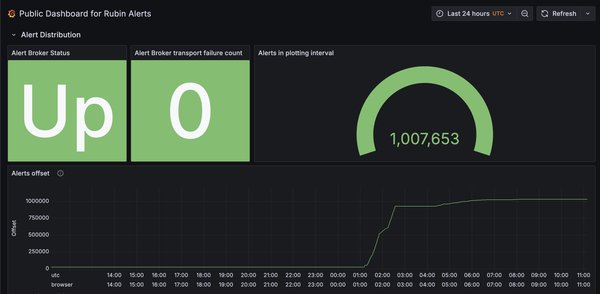
A screenshot of the public dashboard for Rubin alerts, taken during the LSST end-to-end Rubin Observatory data test run. The image shows 1,007,653 discovery alerts successfully processed and shared with the astronomical community in real time.
The Future of the Milky Way Galaxy
The Rubin Observatory is expected to begin its full survey very soon. Once operational, it will provide a continuous stream of discoveries across the whole southern sky, including the MIlky Way galaxy, detecting fainter objects than ever before.
While the volume of data will be immense, LCO’s commitment to providing the software and hardware infrastructure ensures that the global scientific community can prioritize and study the most significant cosmic events as they happen.
Director of Las Cumbres Observatory, Dr. Lisa Storrie-Lombardi, said “It is so gratifying to see the hard work of so many LCO scientists, engineers, and software developers, over more than a decade, come to fruition. LCO is ready for the LSST.”
“There will be so many more discoveries to explore,” Dr. Street said. “Seeing the TOM Toolkit adopted by the community and used exactly as intended has been incredibly rewarding. We are ready to explore the universe more thoroughly than ever before.”

Dr. Rachel Street is Senior Scientist at Las Cumbres Observatory, specializing in exoplanets, microlensing, Rubin Observatory and the Legacy Survey of Space and Time.